just before Craig, Larry.
From Frank Rich's NYT column:
[When House GOP members complained about Nancy Pelosi's "partisan" bailout speech], "Barney Frank taunted his G.O.P. peers with pitch-perfect mockery: 'Somebody hurt my feelings, so I will punish the country!'
Talk about the world coming full circle. This is the same Democrat who had been slurred as 'Barney Fag' in the mid-1990s by Dick Armey, a House leader of the government-bashing Gingrich revolution that helped lower us into this debacle."
Dick Armey really turned another man's name into a homophobic slur? Dick Armey?
Showing posts with label Politics. Show all posts
Showing posts with label Politics. Show all posts
Sunday, October 05, 2008


Thursday, March 27, 2008
Good News on Easter Morning: Global Warming is a Hoax, Nothing to Worry About Here*
It would be nice to find a job that offers me real insurance, the kind that John McCain has but doesn't want to offer to we pesky Americans who don't get government managed care courtesy of the U.S. Senate.
*I regret to inform you that global climate change is probably not an extremely elaborate hoax, but is instead a serious danger to future generations/the earth's poor/all of us. But the preacher who suggested that it is a hoax backed up his claim by commenting on how cold it's been in Yellowstone this year. Yeah, I almost walked out.
And not to forget the music. My sister, who has great taste in music/art/clothing/etc., and I were just talking about Los Campesinos! And they're fun. So you should check them out.
Los Campesinos- Death to Los Campesinos
RIYL- Broken Social Scene, Stars, British accents, people who are fans of indie rock and decide to start their own band.
*I regret to inform you that global climate change is probably not an extremely elaborate hoax, but is instead a serious danger to future generations/the earth's poor/all of us. But the preacher who suggested that it is a hoax backed up his claim by commenting on how cold it's been in Yellowstone this year. Yeah, I almost walked out.
And not to forget the music. My sister, who has great taste in music/art/clothing/etc., and I were just talking about Los Campesinos! And they're fun. So you should check them out.
Los Campesinos- Death to Los Campesinos
RIYL- Broken Social Scene, Stars, British accents, people who are fans of indie rock and decide to start their own band.
Tuesday, March 18, 2008
A More Perfect Union
Obama's speech on race in America. Read it. Watch it. Whatever. This is a really impressive speech.
"This union may never be perfect, but generation after generation has shown that it can always be perfected. And today, whenever I find myself feeling doubtful or cynical about this possibility, what gives me the most hope is the next generation - the young people whose attitudes and beliefs and openness to change have already made history in this election."
Ben Harper- Morning Yearning
RIYL- Guys with acoustic guitars, Amos Lee
"This union may never be perfect, but generation after generation has shown that it can always be perfected. And today, whenever I find myself feeling doubtful or cynical about this possibility, what gives me the most hope is the next generation - the young people whose attitudes and beliefs and openness to change have already made history in this election."
Ben Harper- Morning Yearning
RIYL- Guys with acoustic guitars, Amos Lee
Thursday, March 13, 2008
No. Just...no
Ok, so this is going to be my second Andrew/Obama link in a row. I told you that I'm heating up.
A suggestion from Andrew for the hypothetically elected Barack Obama:
I'm going to go ahead and give Andrew points for trying to be both reasonable and optimistic. Gates has done a surprisingly good job with the cards that he was dealt. By all accounts he has taken a realistic approach to the war in Iraq, favoring strategies that will reduce violence towards civilians without needlessly endangering U.S. troops. So kudos to Gates for a job well done, and to Andrew for recognizing it.
That being said, this has got to be one of the worst ideas that Andrew has had this election season. If politics suddenly became, well, not in fact politics, but instead some sort of public policy meritocracy, then this would be a fantastic idea. Andrew is right, we should reward people, of all ideologies, for doing their jobs well. Good ideas, and the people behind them, should rise to the top.
Making a decision like this, in an ideal world, would be the sort of move that could build goodwill across the aisle and create a coalition for withdrawal. It would also send a bold statement to the American people that Obama is serious about creating a post-partisan Washington. This is, I think, where Andrew was going with this, and again, he does deserve credit for "being the change that we want to see in the world." It would certainly be unexpected, and in a different era might be a really good thing.
But we do not yet inhabit that world. In our world, Gates is a proxy for Bush's failed war. In the same way that Colin Powell provided cover for launching this disaster, Gates has become a screen of respectability that Rumsfeld clearly could not provide. Even as Cheney rattles the saber over Iran, pundits sleep better at night knowing that Gates is there to be a voice of reason. Gates' presence in the administration makes the entire organization seem much more sane. And this is precisely the problem.
Obama is running on change, especially foreign policy change, and especially foreign policy change in Iraq. To leave in place Gates as Secretary of Defense might be sound military strategy, but it is undoubtedly a political poison pill. To keep Gates in gives legitimacy to Bush and weakens Obama's narrative of change. Nine years later, the 2000 Nader fallacy that Bush and Gore were the same person actually becomes true in some strange sense. In addition, Hannity, Beck, Limbaugh, The Corner, Brookings, etc., get to trumpet the greatness that was Bush while furthering the narrative that Democrats have no idea what they are doing when it comes to the military/defense. I cannot stress how important it is to fight this narrative.
So long as Republicans are seen as the party of the military, no matter how much they screw it up, Democrats will never be able to lead the country abroad, or make effective critiques of the Republican establishment. As it stands now, Republican military decisions are brave and patriotic, while Democratic decisions are weak and uninformed. This is such a strong narrative that Hillary Clinton has embraced it by moving to the right on defense, which not only leads her to vote for crazy things, but also gives Republicans an added boost of legitimacy. Many Democrats followed Bush into war when high profile people like Clionton did not speak out against it. Think she learned her lesson? See: Last week when she argued that John "100 Years in Iraq" McCain would make a better leader than Obama. Yeah. I will note that this is not to favor one party over the other, although I clearly do, just to say that a one party in charge of the military situation is a terrible thing for democracy. Do we need more evidence of that?
If Bob Gates were the only possible person who could do the job, clearly that would be a different matter. But he's not. So let's leave the Republican-in-the-administration appointment for something else, shall we? Clinton really does have Andrew rattled. He needs to get his head back in the game.
Sunset Rubdown- Us Ones In Between
RIYL- Wolf Parade, Modest Mouse, Clap Your Hands, Say Yeah!, TV On the Radio
Ed. note: This is probably my favorite songwriter at the moment. I have been trying to get Wes into his stuff but he can't get past the vocals. What a shame.
A suggestion from Andrew for the hypothetically elected Barack Obama:
Talking out loud with Marc Ambinder yesterday, I realized that I hoped a president Obama would ask Bob Gates to stay on as defense secretary. Gates has been one of the real stars of the Bush second term, managing to guide the military between the rapids of Cheney and the rocks of reality. He's an immensely impressive, level-headed, pragmatic conservative, and he wouldn't, I think, be immune to outreach from an incoming Democratic administration faced with extreme challenges in the Middle East. No such arrangement could be made before the election, of course. But I figured it would be worth airing the possibility.
I'm going to go ahead and give Andrew points for trying to be both reasonable and optimistic. Gates has done a surprisingly good job with the cards that he was dealt. By all accounts he has taken a realistic approach to the war in Iraq, favoring strategies that will reduce violence towards civilians without needlessly endangering U.S. troops. So kudos to Gates for a job well done, and to Andrew for recognizing it.
That being said, this has got to be one of the worst ideas that Andrew has had this election season. If politics suddenly became, well, not in fact politics, but instead some sort of public policy meritocracy, then this would be a fantastic idea. Andrew is right, we should reward people, of all ideologies, for doing their jobs well. Good ideas, and the people behind them, should rise to the top.
Making a decision like this, in an ideal world, would be the sort of move that could build goodwill across the aisle and create a coalition for withdrawal. It would also send a bold statement to the American people that Obama is serious about creating a post-partisan Washington. This is, I think, where Andrew was going with this, and again, he does deserve credit for "being the change that we want to see in the world." It would certainly be unexpected, and in a different era might be a really good thing.
But we do not yet inhabit that world. In our world, Gates is a proxy for Bush's failed war. In the same way that Colin Powell provided cover for launching this disaster, Gates has become a screen of respectability that Rumsfeld clearly could not provide. Even as Cheney rattles the saber over Iran, pundits sleep better at night knowing that Gates is there to be a voice of reason. Gates' presence in the administration makes the entire organization seem much more sane. And this is precisely the problem.
Obama is running on change, especially foreign policy change, and especially foreign policy change in Iraq. To leave in place Gates as Secretary of Defense might be sound military strategy, but it is undoubtedly a political poison pill. To keep Gates in gives legitimacy to Bush and weakens Obama's narrative of change. Nine years later, the 2000 Nader fallacy that Bush and Gore were the same person actually becomes true in some strange sense. In addition, Hannity, Beck, Limbaugh, The Corner, Brookings, etc., get to trumpet the greatness that was Bush while furthering the narrative that Democrats have no idea what they are doing when it comes to the military/defense. I cannot stress how important it is to fight this narrative.
So long as Republicans are seen as the party of the military, no matter how much they screw it up, Democrats will never be able to lead the country abroad, or make effective critiques of the Republican establishment. As it stands now, Republican military decisions are brave and patriotic, while Democratic decisions are weak and uninformed. This is such a strong narrative that Hillary Clinton has embraced it by moving to the right on defense, which not only leads her to vote for crazy things, but also gives Republicans an added boost of legitimacy. Many Democrats followed Bush into war when high profile people like Clionton did not speak out against it. Think she learned her lesson? See: Last week when she argued that John "100 Years in Iraq" McCain would make a better leader than Obama. Yeah. I will note that this is not to favor one party over the other, although I clearly do, just to say that a one party in charge of the military situation is a terrible thing for democracy. Do we need more evidence of that?
If Bob Gates were the only possible person who could do the job, clearly that would be a different matter. But he's not. So let's leave the Republican-in-the-administration appointment for something else, shall we? Clinton really does have Andrew rattled. He needs to get his head back in the game.
Sunset Rubdown- Us Ones In Between
RIYL- Wolf Parade, Modest Mouse, Clap Your Hands, Say Yeah!, TV On the Radio
Ed. note: This is probably my favorite songwriter at the moment. I have been trying to get Wes into his stuff but he can't get past the vocals. What a shame.
Wednesday, March 12, 2008
Like writing my thesis all over again.
Andrew links to a moving speech by Barack Obama about his stance on abortion that touches on both his relationship to voters and the role of faith in public life. As someone who identifies deeply as both an Evangelical and a feminist, abortion gives me fits. How anyone does not struggle with this issue, perhaps above all others, is beyond me.
Happily, this is just one more reminder about what has already been made abundantly clear: we need more of this type of honesty, humility, and reflection in our leaders. As Bryce is slowing down on the politics blogging, I'm just about to heat up.
Broken Social Scene- Looks Just Like the Sun
RIYL: Stars, Indie/Dream Pop, The Shins
I embedded this one as an extra incentive to listen. Sounds like summer.
Happily, this is just one more reminder about what has already been made abundantly clear: we need more of this type of honesty, humility, and reflection in our leaders. As Bryce is slowing down on the politics blogging, I'm just about to heat up.
Broken Social Scene- Looks Just Like the Sun
RIYL: Stars, Indie/Dream Pop, The Shins
I embedded this one as an extra incentive to listen. Sounds like summer.
Thursday, February 14, 2008
Best. Blog. Name. Ever.
Ezra Klein's got a great post up over at Momma Said Wonk You Out about why health insurers suck (his words, not mine). Not that I disagree with the sentiment. Definitely worth a read, especially if you are thinking of voting Democratic this year.
My biggest complaint so far about getting care has been the way in which buying into a plan is in no way friendly to consumers. Market pressures that force cell phone companies to explain what plan you are buying and how much it will cost do not seem to have impacted health insurers. Klein's explanation for why the market has failed when it comes to health makes a lot of sense.
From a policy perspective, Klein seems to favor Hillarycare over Obama's plan. As an Obama supporter, that bums me out. But his criticism seems legitimate. Obama really does seem to dislike mandates, but it's difficult to see how the system can be reformed without them. I'd love to hear a detailed criticism of mandates, but for the time being I'm content to trust Klein's judgment on this one. He is definitely a wonk, and health care policy is his area of expertise. I'll be interested to see whether Obama actually moves left on this one after he becomes president, or whether his resistance to Hillarycare is genuine.
My biggest complaint so far about getting care has been the way in which buying into a plan is in no way friendly to consumers. Market pressures that force cell phone companies to explain what plan you are buying and how much it will cost do not seem to have impacted health insurers. Klein's explanation for why the market has failed when it comes to health makes a lot of sense.
From a policy perspective, Klein seems to favor Hillarycare over Obama's plan. As an Obama supporter, that bums me out. But his criticism seems legitimate. Obama really does seem to dislike mandates, but it's difficult to see how the system can be reformed without them. I'd love to hear a detailed criticism of mandates, but for the time being I'm content to trust Klein's judgment on this one. He is definitely a wonk, and health care policy is his area of expertise. I'll be interested to see whether Obama actually moves left on this one after he becomes president, or whether his resistance to Hillarycare is genuine.
Wednesday, December 05, 2007
Exile from Mainstream
Josh Marshall really knows the way to a boy's heart. Talking Points Media have a post up from Brian McLaren talking about his new book Everything Must Change: Jesus, Global Crises, and a Revolution of Hope.
The post itself isn't really life-changing, but the fact that TPM gave him the chance to promote it is encouraging news. What I sometimes forget is that the real world has no idea what Evangelicals are really like. And if the past year has taught me anything, it is that the information they do receive about us/them is not very encouraging. See: "Jesus Camp," anything James Dobson related, the Creation Museum, and President Bush. Basically, we are only known for doing bad and crazy stuff. The good stuff just doesn't penetrate. The parts of me that have stopped identifying as Evangelical really don't care that much. If they want to ruin their reputation then that's there prerogative. However, there is a part of me that will always identify with being an Evangelical. I can't walk away from that any more than I could walk away from W.N.L., or my Michael W. Smith tapes, or "true love waits." So in a roundabout way this really is important to me. Donald Miller has stated that the church needs to stop trying to do a P.R. campaign for Jesus. That's true. Love speaks for itself. But having the church shown as a destructive force isn't good either.
To have a rational, sane Evangelical preacher with rational, sane thoughts on the world is refreshing, healthy, and helpful. Even more so when that person is given a national platform. Talking Points Media is extremely influential right now and deservedly so, they do important work. Serious people take this place, well, seriously. With this post people who have heard about "Jesus Camp," but don't actually know any normal Evangelical Christians, now have some exposure to someone who both loves Jesus and speaks in a really humble way. Great, huh?
I am, by the way, really looking forward to reading this book. Especially since Just Coffee is the OFFICIAL coffee of his book tour. Seriously).
The post itself isn't really life-changing, but the fact that TPM gave him the chance to promote it is encouraging news. What I sometimes forget is that the real world has no idea what Evangelicals are really like. And if the past year has taught me anything, it is that the information they do receive about us/them is not very encouraging. See: "Jesus Camp," anything James Dobson related, the Creation Museum, and President Bush. Basically, we are only known for doing bad and crazy stuff. The good stuff just doesn't penetrate. The parts of me that have stopped identifying as Evangelical really don't care that much. If they want to ruin their reputation then that's there prerogative. However, there is a part of me that will always identify with being an Evangelical. I can't walk away from that any more than I could walk away from W.N.L., or my Michael W. Smith tapes, or "true love waits." So in a roundabout way this really is important to me. Donald Miller has stated that the church needs to stop trying to do a P.R. campaign for Jesus. That's true. Love speaks for itself. But having the church shown as a destructive force isn't good either.
To have a rational, sane Evangelical preacher with rational, sane thoughts on the world is refreshing, healthy, and helpful. Even more so when that person is given a national platform. Talking Points Media is extremely influential right now and deservedly so, they do important work. Serious people take this place, well, seriously. With this post people who have heard about "Jesus Camp," but don't actually know any normal Evangelical Christians, now have some exposure to someone who both loves Jesus and speaks in a really humble way. Great, huh?
I am, by the way, really looking forward to reading this book. Especially since Just Coffee is the OFFICIAL coffee of his book tour. Seriously).
Friday, September 07, 2007
It's Giuliani Time!

My new buddy Karen* (yes, the funny engineering video Karen) reminded me of my project to talk about each one of the oh-so-many 2008 candidates for POTUS. The problem with that little project, as I see it, is that so many of them are so obviously lackluster. I mean...Romney? Really? President? How am I supposed to write an entire post about that?
But I'd still like to finish it. So here is my post for "America's Mayor," Rudy Giuliani.
As a rule, trite poilitical attack names (Slick Willy, Shrub, Al Bore) are created simply because they are catchy. At times they have some sort of foundation in truth ("The Decider" comes to mind), but for the most part they are only useful for making someone look childish (although it's debatable whether the person using the name is, in fact, the childish one).
In the case of Rudy Giuliani, the label "President of 9/11" is not only catchy, but actually seems to be 100% accurate. Has anyone, any single person, actually heard him talk about something that wasn't A)Iraq, B)Iran, C)9/11, or D)Terrorism? I mean, really. I'm not saying that these aren't important issues (although I could make that argument). I'm saying that, outside of his argument that we are all going to die if we don't invade more countries(!), he really doesn't have anything going for him. And since I don't find that argument convincing...well, you get the picture.
You could say that, even though he doesn't talk about it much, running New York shows his capability for the job. But New Yorkers don't seem to like him very much.
Actually, whether it's "America's Mayor" Rudy, or "President of 9/11" Rudy, this is really going to hurt his case. Not only do these New Yorkers not like him, they also think he did a really terrible job with 9/11. Ouch.
I think I'll leave it at that. Talking about what Giuliani would do to the Constitution is a sure way to find myself in a paranoid depression.
*Karen was kind enough to send me this not at all doctored picture. My shocked face represents my fear that Giuliani is about to lecture me on how afraid I should be that anyone else might win the election.
Friday, May 11, 2007
High Fructose Corn Syrup Will Never Taste As Sweet to Me Again

So this is a little hat tip to something that I've been obsessing over lately and even discussing with some of my friends (hello Evangelical Environmental Network!). While working down here on the border I have become (even more) fascinated by the interconnectedness of our world. I have spent so much time this year thinking about the ways in which migration, economics, agriculture, the environment, etc. are all linked to one another. And this great article, written by Michael Pollan, talks about just that.
To try and cut down on the length of this post (and therefore increase your likelihood of reading it) I'm going to do this in two parts. I'm pasting the article below for your reading pleasure (it can also be found right here in a more legal setting). A few days from now (give or take) I'm going to be writing a little follow-up piece with some further thoughts and a few more links to make this conversation more interesting.
By MICHAEL POLLAN
Published: April 22, 2007
The New York Times Magazine
A few years ago, an obesity researcher at the University of Washington named Adam Drewnowski ventured into the supermarket to solve a mystery. He wanted to figure out why it is that the most reliable predictor of obesity in America today is a person's wealth. For most of history, after all, the poor have typically suffered from a shortage of calories, not a surfeit. So how is it that today the people with the least amount of money to spend on food are the ones most likely to be overweight?
Drewnowski gave himself a hypothetical dollar to spend, using it to purchase as many calories as he possibly could. He discovered that he could buy the most calories per dollar in the middle aisles of the supermarket, among the towering canyons of processed food and soft drink. (In the typical American supermarket, the fresh foods — dairy, meat, fish and produce — line the perimeter walls, while the imperishable packaged goods dominate the center.) Drewnowski found that a dollar could buy 1,200 calories of cookies or potato chips but only 250 calories of carrots. Looking for something to wash down those chips, he discovered that his dollar bought 875 calories of soda but only 170 calories of orange juice.
As a rule, processed foods are more "energy dense" than fresh foods: they contain less water and fiber but more added fat and sugar, which makes them both less filling and more fattening. These particular calories also happen to be the least healthful ones in the marketplace, which is why we call the foods that contain them "junk." Drewnowski concluded that the rules of the food game in America are organized in such a way that if you are eating on a budget, the most rational economic strategy is to eat badly — and get fat.
This perverse state of affairs is not, as you might think, the inevitable result of the free market. Compared with a bunch of carrots, a package of Twinkies, to take one iconic processed foodlike substance as an example, is a highly complicated, high-tech piece of manufacture, involving no fewer than 39 ingredients, many themselves elaborately manufactured, as well as the packaging and a hefty marketing budget. So how can the supermarket possibly sell a pair of these synthetic cream-filled pseudocakes for less than a bunch of roots?
For the answer, you need look no farther than the farm bill. This resolutely unglamorous and head-hurtingly complicated piece of legislation, which comes around roughly every five years and is about to do so again, sets the rules for the American food system — indeed, to a considerable extent, for the world's food system. Among other things, it determines which crops will be subsidized and which will not, and in the case of the carrot and the Twinkie, the farm bill as currently written offers a lot more support to the cake than to the root. Like most processed foods, the Twinkie is basically a clever arrangement of carbohydrates and fats teased out of corn, soybeans and wheat — three of the five commodity crops that the farm bill supports, to the tune of some $25 billion a year. (Rice and cotton are the others.) For the last several decades — indeed, for about as long as the American waistline has been ballooning — U.S. agricultural policy has been designed in such a way as to promote the overproduction of these five commodities, especially corn and soy.
That's because the current farm bill helps commodity farmers by cutting them a check based on how many bushels they can grow, rather than, say, by supporting prices and limiting production, as farm bills once did. The result? A food system awash in added sugars (derived from corn) and added fats (derived mainly from soy), as well as dirt-cheap meat and milk (derived from both). By comparison, the farm bill does almost nothing to support farmers growing fresh produce. A result of these policy choices is on stark display in your supermarket, where the real price of fruits and vegetables between 1985 and 2000 increased by nearly 40 percent while the real price of soft drinks (a k a liquid corn) declined by 23 percent. The reason the least healthful calories in the supermarket are the cheapest is that those are the ones the farm bill encourages farmers to grow.
A public-health researcher from Mars might legitimately wonder why a nation faced with what its surgeon general has called "an epidemic" of obesity would at the same time be in the business of subsidizing the production of high-fructose corn syrup. But such is the perversity of the farm bill: the nation's agricultural policies operate at cross-purposes with its public-health objectives. And the subsidies are only part of the problem. The farm bill helps determine what sort of food your children will have for lunch in school tomorrow. The school-lunch program began at a time when the public-health problem of America's children was undernourishment, so feeding surplus agricultural commodities to kids seemed like a win-win strategy. Today the problem is overnutrition, but a school lunch lady trying to prepare healthful fresh food is apt to get dinged by U.S.D.A. inspectors for failing to serve enough calories; if she dishes up a lunch that includes chicken nuggets and Tater Tots, however, the inspector smiles and the reimbursements flow. The farm bill essentially treats our children as a human Disposall for all the unhealthful calories that the farm bill has encouraged American farmers to overproduce.
To speak of the farm bill's influence on the American food system does not begin to describe its full impact — on the environment, on global poverty, even on immigration. By making it possible for American farmers to sell their crops abroad for considerably less than it costs to grow them, the farm bill helps determine the price of corn in Mexico and the price of cotton in Nigeria and therefore whether farmers in those places will survive or be forced off the land, to migrate to the cities — or to the United States. The flow of immigrants north from Mexico since Nafta is inextricably linked to the flow of American corn in the opposite direction, a flood of subsidized grain that the Mexican government estimates has thrown two million Mexican farmers and other agricultural workers off the land since the mid-90s. (More recently, the ethanol boom has led to a spike in corn prices that has left that country reeling from soaring tortilla prices; linking its corn economy to ours has been an unalloyed disaster for Mexico's eaters as well as its farmers.) You can't fully comprehend the pressures driving immigration without comprehending what U.S. agricultural policy is doing to rural agriculture in Mexico.
And though we don't ordinarily think of the farm bill in these terms, few pieces of legislation have as profound an impact on the American landscape and environment. Americans may tell themselves they don't have a national land-use policy, that the market by and large decides what happens on private property in America, but that's not exactly true. The smorgasbord of incentives and disincentives built into the farm bill helps decide what happens on nearly half of the private land in America: whether it will be farmed or left wild, whether it will be managed to maximize productivity (and therefore doused with chemicals) or to promote environmental stewardship. The health of the American soil, the purity of its water, the biodiversity and the very look of its landscape owe in no small part to impenetrable titles, programs and formulae buried deep in the farm bill.
Given all this, you would think the farm-bill debate would engage the nation's political passions every five years, but that hasn't been the case. If the quintennial antidrama of the "farm bill debate" holds true to form this year, a handful of farm-state legislators will thrash out the mind-numbing details behind closed doors, with virtually nobody else, either in Congress or in the media, paying much attention. Why? Because most of us assume that, true to its name, the farm bill is about "farming," an increasingly quaint activity that involves no one we know and in which few of us think we have a stake. This leaves our own representatives free to ignore the farm bill, to treat it as a parochial piece of legislation affecting a handful of their Midwestern colleagues. Since we aren't paying attention, they pay no political price for trading, or even selling, their farm-bill votes. The fact that the bill is deeply encrusted with incomprehensible jargon and prehensile programs dating back to the 1930s makes it almost impossible for the average legislator to understand the bill should he or she try to, much less the average citizen. It's doubtful this is an accident.
But there are signs this year will be different. The public-health community has come to recognize it can't hope to address obesity and diabetes without addressing the farm bill. The environmental community recognizes that as long as we have a farm bill that promotes chemical and feedlot agriculture, clean water will remain a pipe dream. The development community has woken up to the fact that global poverty can't be fought without confronting the ways the farm bill depresses world crop prices. They got a boost from a 2004 ruling by the World Trade Organization that U.S. cotton subsidies are illegal; most observers think that challenges to similar subsidies for corn, soy, wheat or rice would also prevail.
And then there are the eaters, people like you and me, increasingly concerned, if not restive, about the quality of the food on offer in America. A grass-roots social movement is gathering around food issues today, and while it is still somewhat inchoate, the manifestations are everywhere: in local efforts to get vending machines out of the schools and to improve school lunch; in local campaigns to fight feedlots and to force food companies to better the lives of animals in agriculture; in the spectacular growth of the market for organic food and the revival of local food systems. In great and growing numbers, people are voting with their forks for a different sort of food system. But as powerful as the food consumer is — it was that consumer, after all, who built a $15 billion organic-food industry and more than doubled the number of farmer's markets in the last few years — voting with our forks can advance reform only so far. It can't, for example, change the fact that the system is rigged to make the most unhealthful calories in the marketplace the only ones the poor can afford. To change that, people will have to vote with their votes as well — which is to say, they will have to wade into the muddy political waters of agricultural policy.
Doing so starts with the recognition that the "farm bill" is a misnomer; in truth, it is a food bill and so needs to be rewritten with the interests of eaters placed first. Yes, there are eaters who think it in their interest that food just be as cheap as possible, no matter how poor the quality. But there are many more who recognize the real cost of artificially cheap food — to their health, to the land, to the animals, to the public purse. At a minimum, these eaters want a bill that aligns agricultural policy with our public-health and environmental values, one with incentives to produce food cleanly, sustainably and humanely. Eaters want a bill that makes the most healthful calories in the supermarket competitive with the least healthful ones. Eaters want a bill that feeds schoolchildren fresh food from local farms rather than processed surplus commodities from far away. Enlightened eaters also recognize their dependence on farmers, which is why they would support a bill that guarantees the people who raise our food not subsidies but fair prices. Why? Because they prefer to live in a country that can still produce its own food and doesn't hurt the world's farmers by dumping its surplus crops on their markets.
The devil is in the details, no doubt. Simply eliminating support for farmers won't solve these problems; overproduction has afflicted agriculture since long before modern subsidies. It will take some imaginative policy making to figure out how to encourage farmers to focus on taking care of the land rather than all-out production, on growing real food for eaters rather than industrial raw materials for food processors and on rebuilding local food economies, which the current farm bill hobbles. But the guiding principle behind an eater's farm bill could not be more straightforward: it's one that changes the rules of the game so as to promote the quality of our food (and farming) over and above its quantity.
Such changes are radical only by the standards of past farm bills, which have faithfully reflected the priorities of the agribusiness interests that wrote them. One of these years, the eaters of America are going to demand a place at the table, and we will have the political debate over food policy we need and deserve. This could prove to be that year: the year when the farm bill became a food bill, and the eaters at last had their say.
Michael Pollan, a contributing writer, is the Knight professor of journalism at the University of California, Berkeley. His most recent book is "The Omnivore's Dilemma."
(In the photo: Michael Pollan in all his glory)
Sunday, April 01, 2007
All the king's horses and all the king's men
One by one they all fall away.
Taken from the New York Times via Josh Marshall
I hope to see Mr. Dowd in "Africa or South America doing something that was like mission work" one of these days. I imagine the two of us sitting down to a meal of fresh fruit, rice, and free range meat, imagining a world of greater "gentleness."
The world is changing.
Taken from the New York Times via Josh Marshall
I hope to see Mr. Dowd in "Africa or South America doing something that was like mission work" one of these days. I imagine the two of us sitting down to a meal of fresh fruit, rice, and free range meat, imagining a world of greater "gentleness."
The world is changing.
Thursday, March 29, 2007
Meet Your (Legalized?) Neighbors
This is going to be a long one.
As some of you may know, and as most of you almost certainly don't, a piece of legislation was introduced into the House of Representatives this week under the name the "Gutierrez-Flake STRIVE Act of 2007." From what I can tell it made a very small splash.
To make an almost seven hundred page piece of public policy mercifully short, it's an immigration bill. The jury seems to be hung on whether it's the one we've been waiting for.
Some specifics for you, as digested by me:
I think I'll fill this out in a later post, but many of the terms that I used here I strongly disagree with. Illegal, undocumented, amnesty, operational control...I could go on. I think that they obscure the truth and treat good people like criminals as an operating principle. Just for the record.
By the way, in spite of this post and my last one, I got a surprising amount of work done today. Some days you just have to blog. Some days you just have to work. I guess today was both. Academic deconstruction, public policy analysis, and non-profit social justice work. Plus I ate an avocado AND at my favorite burrito joint. Aaron's day for the win. On the other hand I only slept four hours last night. I've been up since three in the morning. I'm bound to crash soon.
As some of you may know, and as most of you almost certainly don't, a piece of legislation was introduced into the House of Representatives this week under the name the "Gutierrez-Flake STRIVE Act of 2007." From what I can tell it made a very small splash.
To make an almost seven hundred page piece of public policy mercifully short, it's an immigration bill. The jury seems to be hung on whether it's the one we've been waiting for.
Some specifics for you, as digested by me:
- This STRIVE Act includes amnesty. That means, more or less, that anyone living inside the United States without proper U.S. documentation since June 1st, 2006 or before will be given the opportunity to gain legal status, and eventually the possibility of citizenship. Among the criteria that must be met are proof of employment, a criminal background check, and payment of a series of fines. Not surprisingly, the details are complicated. Supposedly priority would be given to reuniting families.
- A new type of visa, the H-2C, would be created to accommodate at least 400,000 new temporary immigrant workers per year. Workers would be given legal status for a period of 3 years, with the possibility of a further three year extension. Spouses and children would be given legal residency status during this period as well. Workers would be forced to leave the country if employment lapsed for more than 60 days. Employers hiring these workers would be required to prove that they first sought, and failed to find, domestic employees. This program would be monitored by a new, still undeveloped, electronic government system to be implemented at businesses across the country. The employment of unauthorized immigrant workers would carry stricter punishments.
- Both the DREAM Act of 2007 and the AgJOBS Act of 2007 are included in the larger bill. The DREAM Act works to allow undocumented children in the United States to pursue their education past the high school level. The AgJOBS Act specifically targets migrants seeking employment in agriculture and offers them modified benefits for consistent work in this area.
- Large amounts of new funding would be allocated to the Department of Homeland Security to ensure "operational control" of the border. This is a fancy little Border Patrol term that means that we decide who comes in and who doesn't. Technology, staff, and infrastructure would all be increased drastically. That means more cameras, more helicopters, more trucks, more agents, more buildings, more fence, more roads. More more more. The amnesty and legal guest worker clauses in the law would only be implemented after the DHS can prove to an unspecified degree that border security is being increased and that the employee tracking system has been designed and implemented.
- Increased penalties and enforcement for illegal smuggling, gang activities, etc., having to do with illegal immigrants.
That's basically it. Now let's break this thing down.
- Amnesty is going to be highly unpopular with a massive number of people living in the United States. Lou Dobbs might literally explode in outrage. Why? The Reagan amnesty, more than any other single factor, is blamed by many people to have caused such a massive surge in immigration. A second amnesty, in their view, would be repeating this fatal mistake. In some ways it's a valid criticism. Why reward people for breaking the law? Why reward people who broke the law last year but not any of the people who want to come to the United States right now? There's a simple answer for all of that. Basically, amnesty is a compromise. It recognizes the work that illegal immigrants have done in this country and accepts that we can't really kick them out now.It's a way to bring millions of people, some who have lived almost their entire lives here, into the folds of the United States' legal order. This is good for everyone. Immigrants will be more likely to report crimes without fear for their own status. They will be more able to participate in the conventional economy, a boon for everybody. It's a win-win-win-win-win situation, as many people are stating. Amnesty, in my view, is good. The way this amnesty is done isn't. Some estimates for the time it would take to achieve citizenship are as high as 25 years. What, exactly, is the point of that? Who does it benefit? And how long will it be before the system even kicks in? Before you dismiss this criticism as unimportant, think about the logistical nightmare, for everyone, that millions of people trapped in legal limbo would create. How is that even being proposed as a policy? That's the current policy with a sugar coating.
- Worker visas. The good: We are currently arresting 1.2 million people a year as they try to cross illegally into this country. Worker visas are a very good way to bring those people out of the deserts and through the ports of entry. This would save lives, make border enforcement both possible and ethical, and legalize millions of hard workers and the people who employ them. Sounds great. The bad: Again, this system would not kick in until some unspecified date. Securing the borders means getting workers out of the desert. One is impossible without the other. Temporary visas, while having some attractive qualities (more participants, the ability for people to earn money and return to their country, etc.), invite all sorts of unethical business practices. Nothing says "take advantage of me!" like the guarantee that in a short time they will be gone. Strikes? You don't work for 60 days, you're gone. No provision for workers organizing. That's bad for all laborers in the U.S. You know what else is potentially bad for all U.S. workers? Short term employees of any kind. Long term health care? Retirement benefits? Higher wages? All of these things could suffer, depending on the fields of employment, when you have a large and disposable pool of workers. And now the ugly: Speaking of disposable, where are the worker protections in this bill? If a worker loses his arm in a meat plant, what rights are that worker guaranteed? Their family? Also terrible, but more so from a policy perspective, who actually thinks that the government can set up this program to hold employers accountable? Who actually wants them to? Are they going to somehow lure away google engineers to do it? It's enough to make any liberal want to starve the beast.
- Agricultural workers are clearly needed. Molly sent me an article talking about how Colorado, after tough new enforcement standards scared of laborers, is using prisoners to do the field work once done by migrants. But is it good for a nation that is morbidly obese (literally, 3 in 5 overweight, 1 in 5 obese) to have an unending supply of cheap food labor? Shouldn't we be pursuing sustainable policies instead, ones that promote a higher quality and lower quantity of food? This might be a pipe dream, but don't forget that once public policy gets made it can be hard to change. A precedent once set is, well, set. Think about it. I clearly won't knock the DREAM Act. Kids going to college? You bet.
- Supporting this one sort of depends on which side you fall on for increasing border militarization. I'm in favor of decreasing it, but I'm not a fan of human trafficking, the violence of the drug smuggling trade, or international gangs. So I think having a few guys watching the line is a good idea. But this is an incredibly stupid way to do it. I'll say it as many times as I can so that the point sticks: the border is impossible to secure without at least 5 times the number of agents we have now, or a drastic decrease in the people trying to cross. Personally I believe that it is impossible to secure in its current state. There is ample evidence to support that. Bizarrely, this is the border equivalent of the Iraq surge. Send more people to realize unspecified goals in an unspecified length of time. Democrats knock it there but want to try it here? Legalizing people is the only way to make them stop crossing illegally in a quick and relatively painless manner. And haven't we pretty much all agreed that these workers are good for the economy? Who's opposing regulating who comes in and out of the country? No one. Stopping illegal crossers means drastically increasing legal ones. When all the maids and cooks and roofers are out of the desert the only people remaining will be the ones you really don't want. Instead, they apparently want to spend tons of time and money on a policy that is killing people, just to appease the military industrial complex (Eisenhower's term, not mine) and the far-right wing. Why? Democrats really need to stop worrying about looking tough and start solving policy problems. It's hard to knock success.
- Increased penalties for committing crimes is another non-starter. Our prisons are already overcrowded. Doesn't it make more sense to enforce the laws that we already have for things like gang activity and smuggling? Again, wouldn't that be a lot easier if we had the people not committing crimes, just looking for work, in a legal system as soon as possible?
So let me put it this way: this is not the bill we've been waiting for. It's got amnesty, sure. It's got the DREAM Act, which you have to be insane not to support. And what else does it have? I guess the promise that maybe at some point in the conceivable future we would get people out of the deserts. But when would that be? And then what? This thing's a mess. But what if it's the only mess we're going to get? I don't think so, and I'll pass. This problem's not going away and there's gotta be a better way than this. Thankfully I think the Senate has a lot more up its sleeve.
I think I'll fill this out in a later post, but many of the terms that I used here I strongly disagree with. Illegal, undocumented, amnesty, operational control...I could go on. I think that they obscure the truth and treat good people like criminals as an operating principle. Just for the record.
By the way, in spite of this post and my last one, I got a surprising amount of work done today. Some days you just have to blog. Some days you just have to work. I guess today was both. Academic deconstruction, public policy analysis, and non-profit social justice work. Plus I ate an avocado AND at my favorite burrito joint. Aaron's day for the win. On the other hand I only slept four hours last night. I've been up since three in the morning. I'm bound to crash soon.
Wednesday, March 07, 2007
I expected the Rocky Mountains to be a little rockier than this.

Dear Dr. Albert Mohler,
"Just when I thought you couldn't get any dumber, you go and do something like this... and totally redeem yourself!"
Love, Aaron
Well, he didn't totally redeem himself, but I respect what he said about Coulter. He didn't totally redeem himself because in the first post, speaking about homosexuality, he said that if a "biological basis is found, and if a prenatal test is then developed, and if a successful treatment to reverse the sexual orientation to heterosexual is ever developed, we would support its use as we should unapologetically support the use of any appropriate means to avoid sexual temptation and the inevitable effects of sin."
In response, I give you Jeremiah 1:5.
"Before I formed you in the womb I knew you,
before you were born I set you apart;
I appointed you as a prophet to the nations."
Albert Mohler, by the way, is the president of Southern Baptist Theological Seminary. He's sort of a big fish you might say.
Albert's probably right though. Using chemicals on a baby seems like what Jesus would want us to do.
*I've got a gold star for the first person to get the quote right!
Saturday, March 03, 2007
Anne Coulter Really Stole My Thunder On Edwards Controversies
You heard it here first. The criticism of Edwards' new house, the request for Kuo to ask about it, the posting of the interview, and now my response.
For those of you who don't know what I'm talking about then scroll down a little bit. It'll all come to you.
As an aside, I highly suggest watching the full beliefnet interview with Edwards, which can be found right here. First and foremost, it was pretty refreshing to see someone who used to work within the George W. Bush White House sit down with a presidential candidate from the Democratic Party for a discussion on personal faith and its role in public life. I thought that the interview itself was great. I really like the questions that Kuo posed, and I was more than impressed by many of the answers that Edwards gave. If you are not going to watch the whole thing then at least try to watch the part where he answers the question about the house.
The residence in question:

This article from the Carolina Journal Online reports that the 28,200 square foot complex, built on 102 acres of property, is valued at over 6 million dollars by the county tax assessor. Apparently it is now the most valuable house in the county.
The "Journal" writes that "the main house is 10,400 square feet and has two garages. The recreation building, a red, barn-like building containing 15,600 square feet, is connected to the house by a closed-in and roofed structure of varying widths and elevations that totals 2,200 square feet," and that "the recreation building contains a basketball court, a squash court, two stages, a bedroom, kitchen, bathrooms, swimming pool, a four-story tower, and a room designated 'John’s Lounge'.”
Just so we all know what's being talked about.
Now on to business. Here's my transcript from that part of the interview:
Kuo: "Does the size of your house undercut your discussion on poverty?"
Edwards : "I think it's a fair question, first of all..I come from a very modest place and I've done well...and we have a very nice physical structure. It's completely unimportant. What matters is what happens inside that structure. I'm not for a minute suggesting that we're saints, or that we've done more than a lot of other people have done, but we have done...(lists "causes"...So, do I think we've done everything we could do? No, I don't think anybody does."
He clearly ducked the question about his house. To be honest, he didn't even duck it that well. What he tried to do, after a few brief remarks, was to steer the conversation away from his house and towards his charitable giving as well as his involvement in various "causes." If there's one thing I really hate, it's politicians ducking questions.
What is really telling, however, is the way that he explains why the size of his house is unimportant. That one sentence, "What matters is what happens inside that structure," stood out to me more and more as I continued to watch that part of the interview. What does happen inside that structure John? You can go swimming, play a massive game of hide-and-go-seek, plan national campaigns, use one of countless bathrooms...the list is endless really. But you can't identify with 99% of the American people, can you? Not living inside of that house. And let's face it, if you can't identify with Americans, you are definitely not going to be able to identify with the rest of the world. It's not even like he was just trying to keep up with the Jones' either. That's the most expensive house in the county. We get it John, you've done well for yourself.
The thing is, by ducking this question, Edwards called places doubt in my mind about the authenticity of his other answers. He didn't say that he wrestled with the decision, but believed it was ok with God, and compatible with his poverty work. He didn't say that he wanted to use it to further the Kingdom. He said, esentially, that he had done well for himself, so why not? That's just unacceptable to me as a Christian. If you read the Bible, talk about its role in shaping your beliefs on poverty, and still build that house, I believe that there is a fundamental disconnect somewhere. I will not question his faith, but I will question how willing he is to apply it to his own life.
I'm not saying that John Edwards and his family shouldn't enjoy their money in some capacity. I am saying that they have chosen to do so in a way that isolates them from the reality in which the rest of us live. The decision to spend six million dollars on a house that is 3/4 as large as the mansion owned by Bill Gates is just not one that I will ever be able to relate to. Can you relate to it? No matter how many scholarships he gives, or Habitat homes he sponsors, his decision that each member of his family needs more than one million dollars of home will never go away.
Someone once told me that if you want to make good decisions then you should ask for advice from people who have made good decisions in the past. This house makes me extremely skeptical about John Edwards' decisions in the future. Believing that a candidate will make good decisions is sort of an important component in wanting someone to be the leader of the free world.
Of course there is more that could be said. What about the environment? What does that house say about the need to care for this planet in an increasingly populated and industrialized world? What does it say about his commitment to that? I think I've said enough, however. Everything that I wanted to say, save this last little bit:
John, you had a chance to win me back. You had it, and you blew it. It was nice while it lasted. I still might support you for Vice again though.
p.s.- Thanks to Bryce for the link. If you want to see the video clip of Anne Coulter's remarks on Edwards it is posted right here.
Friday, February 23, 2007
Oh Snap
David Kuo is going to be interviewing John Edwards for beliefnet and is asking for questions to be submitted over at his blog.
Apparently I am not the only who thinks he has some explaining to do about the resort he is calling his new family home.
I hope Kuo asks the question. I hope Edwards answers it. This has the potential to narrow my support down to one.
Apparently I am not the only who thinks he has some explaining to do about the resort he is calling his new family home.
I hope Kuo asks the question. I hope Edwards answers it. This has the potential to narrow my support down to one.
Saturday, February 17, 2007
Iran Is In for Spring
Here it is, part two in my continuing series on the 2008 presedential cantidates.
John Edwards (Democratic Party)
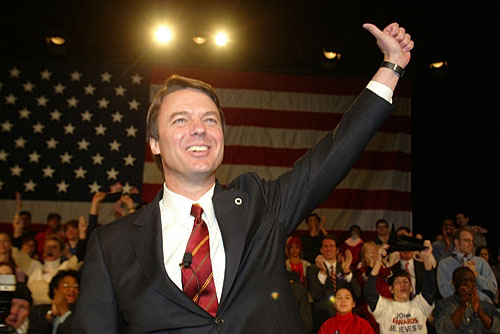 John Edwards, former Senator from North Carolina, first entered my political radar during my sophomore year at Pomona College. At that time the race for the Democratic nomination was still wide open, with Howard Dean's internet campaign just starting to receive a lot of mainstream press, and no candidates really receiving an overwhelming amount of favorable attention from the Democratic leadership.
I was introduced to Edwards by a friend at Pomona who had been asked to help run his campaign in California. From very early on he was an extremely attractive candidate (and not just because he looks like a Land's End model). Unlike John Kerry, Edwards had decided not to seek reelection to the Senate, choosing instead to pursue the presidency without distraction or a backup plan. Edwards was also at the forefront of positive Democratic thinking in the 2004 election. Rather than attacking Bush, a technique favored by Vermont's Governor Dean, or wooing traditional Democratic strongholds like labor, the technique favored by Rep. Dick Gephardt, Edwards sought to push the Democratic party back into a conversation about its ideals and its platform. And he, long before it was the cool thing for Democrats to do, spoke about the role that faith played in his life and in his policies.
Policies that were, and still are, tremendously attractive. He was advocating for universal health care, alleviating poverty, and balancing the budget, and he wanted to do them all at the same time. I know, I wish he'd won too.
Because of his connection to my friend, Edwards ended up coming to Pomona that year and giving a speech in the student center. It was an inspiring talk about poverty in America, and it cemented my support for him in the 2004 election. My faith in Edwards (along with my disdain for Cheney/Bush) was a major reason I was still excited to support Kerry after the convention, even though he himself was, in almost everyone's view, a less than ideal candidate.
And Edwards has continued to impress me. After his loss in the 2004 election he began to travel around the world in an attempt to repair the U.S.' broken image. He also started, and has continued to direct, a public policy think tank focusing on domestic poverty.
Finally, John's devotion to his wife, and his role as a public, pro-feminist husband, has been a breath of fresh air in this political climate. During Elizabeth Edward's very public battle with breast cancer he was a seemingly constant presence. Here's a segment of the official CNN transcript from an interview that John and Elizabeth did on the "Larry King Live" show where Larry asks John if he is worried that his wife might be less attractive because of her cancer treatment:
Edwards gives a great, and really supportive, response to what is a characteristically sleazy question from Larry King.
There was also their joint interview on MSNBC's "Hardball With Chris Matthews" where Matthews came after Elizabeth Edwards and accused them of having an equal marriage. The horror! Here's that segment:
Both John and Elizabeth looked stunned. Equal marriage: 1 MSNBC: 0
So Edwards and I have a lot of good history. As a result, it may surprise you to learn that I'm sort of undecided about supporting him right now. Why? Well, in spite of all that Edwards has to offer (and I still think it is a lot), I believe that there is a fundamental disconnect between the words coming out of his mouth and the money going in and out of his pocket. In my view Edwards is, as they say, a limousine liberal. He's a former trial lawyer that has done very, very well for himself. And he's enjoying that in some very lavish ways.
Newsweek just printed a picture of the new Edwards family compound in North Carolina (yes, compound), which includes a 28,000 (give or take) square foot home. Not including guest house. And that unsettles me. That doesn't speak very well of his understanding of poverty. That doesn't speak very well of his understanding of environmental concerns. To me, all that says is that John Edwards, as he so often talked about in 2004, believes in the existence of two Americas. And he believes in the one where the fantastically wealthy live surreal lives.
That just so happens to be an America that most people will never live in. So why vote for it? I'm certainly not naive. I know that to run for president you need to have more than a few dead ones earning 15% in the market. But that house is just excessive, and, dare I say, hypocritical. I don't like that at all.
John Edwards (Democratic Party)
John Edwards, former Senator from North Carolina, first entered my political radar during my sophomore year at Pomona College. At that time the race for the Democratic nomination was still wide open, with Howard Dean's internet campaign just starting to receive a lot of mainstream press, and no candidates really receiving an overwhelming amount of favorable attention from the Democratic leadership.I was introduced to Edwards by a friend at Pomona who had been asked to help run his campaign in California. From very early on he was an extremely attractive candidate (and not just because he looks like a Land's End model). Unlike John Kerry, Edwards had decided not to seek reelection to the Senate, choosing instead to pursue the presidency without distraction or a backup plan. Edwards was also at the forefront of positive Democratic thinking in the 2004 election. Rather than attacking Bush, a technique favored by Vermont's Governor Dean, or wooing traditional Democratic strongholds like labor, the technique favored by Rep. Dick Gephardt, Edwards sought to push the Democratic party back into a conversation about its ideals and its platform. And he, long before it was the cool thing for Democrats to do, spoke about the role that faith played in his life and in his policies.
Policies that were, and still are, tremendously attractive. He was advocating for universal health care, alleviating poverty, and balancing the budget, and he wanted to do them all at the same time. I know, I wish he'd won too.
Because of his connection to my friend, Edwards ended up coming to Pomona that year and giving a speech in the student center. It was an inspiring talk about poverty in America, and it cemented my support for him in the 2004 election. My faith in Edwards (along with my disdain for Cheney/Bush) was a major reason I was still excited to support Kerry after the convention, even though he himself was, in almost everyone's view, a less than ideal candidate.
And Edwards has continued to impress me. After his loss in the 2004 election he began to travel around the world in an attempt to repair the U.S.' broken image. He also started, and has continued to direct, a public policy think tank focusing on domestic poverty.
Finally, John's devotion to his wife, and his role as a public, pro-feminist husband, has been a breath of fresh air in this political climate. During Elizabeth Edward's very public battle with breast cancer he was a seemingly constant presence. Here's a segment of the official CNN transcript from an interview that John and Elizabeth did on the "Larry King Live" show where Larry asks John if he is worried that his wife might be less attractive because of her cancer treatment:
KING: Senator, has there been any thoughts, and this happens in any case when the male hears the news from the mate, aesthetically how will Elizabeth look?
How will she respond?
Do you have those feelings?
J. EDWARDS: No. No.
KING: No?
J. EDWARDS: Honest to goodness, Larry, the only thing I have thought about is making sure that we have 40 more years together. And Elizabeth and I have been married 27 years. We are physically connected to each other. And we've been through a lot with our children and with our family and our lives. And our lives are completely intertwined. And all that I have thought about is making sure we get her well and that she is there for me and for my kids.
Edwards gives a great, and really supportive, response to what is a characteristically sleazy question from Larry King.
There was also their joint interview on MSNBC's "Hardball With Chris Matthews" where Matthews came after Elizabeth Edwards and accused them of having an equal marriage. The horror! Here's that segment:
E. EDWARDS: There are not that many politicians who are actually very good at jokes. John spoke one time and I said I wouldn‘t even go because it was—he was supposed to be funny and I didn‘t think he could carry it off.
CROWD: (LAUGHTER)
MATTHEWS: I love it. You‘re great. Behind every great man, there‘s a woman trying to kill him.
CROWD: (LAUGHTER)
E. EDWARDS: He has great characteristics.
MATTHEWS: What is it? Does she do this? Does she bust your balls like this when you come home? When you get (INAUDIBLE), does she do that?
CROWD: (APPLAUSE)
E. EDWARDS: My children are watching this.
CROWD: (LAUGHTER)
MATTHEWS: What‘s this with the equal marriages? Why do people marry their equals? It used to be different? What happened to the Stepford wives, the good old days? What happened?
Both John and Elizabeth looked stunned. Equal marriage: 1 MSNBC: 0
So Edwards and I have a lot of good history. As a result, it may surprise you to learn that I'm sort of undecided about supporting him right now. Why? Well, in spite of all that Edwards has to offer (and I still think it is a lot), I believe that there is a fundamental disconnect between the words coming out of his mouth and the money going in and out of his pocket. In my view Edwards is, as they say, a limousine liberal. He's a former trial lawyer that has done very, very well for himself. And he's enjoying that in some very lavish ways.
Newsweek just printed a picture of the new Edwards family compound in North Carolina (yes, compound), which includes a 28,000 (give or take) square foot home. Not including guest house. And that unsettles me. That doesn't speak very well of his understanding of poverty. That doesn't speak very well of his understanding of environmental concerns. To me, all that says is that John Edwards, as he so often talked about in 2004, believes in the existence of two Americas. And he believes in the one where the fantastically wealthy live surreal lives.
That just so happens to be an America that most people will never live in. So why vote for it? I'm certainly not naive. I know that to run for president you need to have more than a few dead ones earning 15% in the market. But that house is just excessive, and, dare I say, hypocritical. I don't like that at all.
Wednesday, February 14, 2007
2008 it is (impeachment is probably too much to hope for)
Once again Bryce has come up with a great idea. Once again I am going to steal it. Before you read another word, head over to his blog to see his thoughts about some of the big names in the 2008 race.
Now that you're back, let me say that I really like the idea of expressing my thoughts about the candidates this early in the race. I am even more excited about the prospect of looking back in two years (or six, or ten) and reflecting on what my impressions were when the race was just starting. Unlike Bryce, I am going to devote one full post to each candidate in order to really flesh out my thoughts. This is going to be a massive project, so it will probably take me a while, but I am determined to see it to fruition.
All horses to the starting gate.
John McCain (The Grand Ole Party)

If I had to pick a time when I first became disenchanted with the modern political machine (and by that I mean the combination of a cynical government and a compliant press), I would undoubtedly choose the 2000 Presidential primary in South Carolina. I was a big fan of John McCain back then. After the years of pettiness that ended the once promising Clinton era, McCain seemed like a breath of fresh air. While I was undoubtedly pulling for Gore, I was still excited about the prospect of a general election race against McCain because I saw it as a no lose situation for the American people.
Bush, clearly the favorite son of the GOP establishment (no pun intended), had been unexpectedly trounced by McCain in New Hampshire, and was losing ground nationally as well. Until South Carolina. In South Carolina, McCain had the decency to oppose the use of the Confederate flag as a part of the official state flag. He had the decency to call out George W. for visiting Bob Jones University, a school that, at the time, did not allow interracial dating. The more time that McCain spent in South Carolina, the more I liked him.
He was doing so well in South Carolina, and the chosen son so poorly, that the decision was made by the Bush team and the GOP that McCain needed to be taken out of the race. And he was. Somehow Bush, aided by the GOP talking heads, was able to accuse McCain, a Vietnam veteran and prisoner of war who had been tortured, of being soft on defense. This is a man who, while still living and still in government, had a naval vessel named after him. Yes, there really is a USS John McCain. Unbelievably, this ridiculous claim stuck. Bush went on to win, decisively, in South Carolina, and was given the GOP nomination at the convention a few months later. We all know how that story turns out.
I can't tell you how devastated I was by what happened in South Carolina. Even as a student of history, the ridiculous claims of the Bush camp, and their shameless coverage by the press, struck me as particularly heinous. At the time I remember thinking "but all of this is just so patently false." In retrospect, those were the good old days. But why bring up all of this history anyway? Isn't this about McCain '08? Well, I bring it up because I think it is important to show just how much of my esteem John McCain has lost.
McCain used to be a man that voters could depend on to speak truth to power, even in the midst of it. Those days are long, long gone. It's sad that so many pundits now use his "Straight Shooter" nickname, and reputation, ironically. Sad, but not uncalled for. Where does one even start? How about his relative silence on immigration while serving as the Senator of a state where it long ago passed into the realm of crisis? Of course there is his very public courting of key figures in the religious right, including Jerry Falwell, a man he once called "an agent of intolerance." Worst of all, perhaps, is McCain's compromise with the Bush administration on torture. Other than campaign finance reform and Senate ethics reform, both of which were badly botched, I cannot name a single thing that McCain has done in the last six years that I like. Come to think of it, I don't have much more of anything to say about this candidate at all. The hope I once found in John McCain has been replaced by little more than regrets about what could have been.
But none of this really matters because, sadly, I am no longer John McCain's target voter. He is clearly looking to rally what Andrew Sullivan calls the "Christianist" base, while hoping that his maverick reputation will still resonate with the independents and libertarians that have supported him for so long. My call: no one is buying it. McCain's base has already largely abandoned him, disgusted by the behavior that I have just listed. And the GOP base? Forget about it. They trust McCain less than they trust Lieberman, and he still caucuses with the Democrats. This is a party that prizes loyalty above all else. Remember Reagan's "Eleventh Commandment," never speak ill of a fellow Republican? Not even his continued support of Bush's surge (cough, escalation) will wash the bad taste out of their mouths.
The only real things that McCain's got going for him at this point are name recognition and his reputation as a war hero. Even if the voters in the general election would pull for him, they will probably never get the chance to decide. Unless the GOP gets REALLY desperate, he will never make it past the primaries. McCain's only hope is that everyone else in the race looks worse than he does. Fortunately for him, his major competitors at this point are Giuliani and Romney. Actually, McCain '08 is starting to look pretty plausible after all.
Now that you're back, let me say that I really like the idea of expressing my thoughts about the candidates this early in the race. I am even more excited about the prospect of looking back in two years (or six, or ten) and reflecting on what my impressions were when the race was just starting. Unlike Bryce, I am going to devote one full post to each candidate in order to really flesh out my thoughts. This is going to be a massive project, so it will probably take me a while, but I am determined to see it to fruition.
All horses to the starting gate.
John McCain (The Grand Ole Party)
If I had to pick a time when I first became disenchanted with the modern political machine (and by that I mean the combination of a cynical government and a compliant press), I would undoubtedly choose the 2000 Presidential primary in South Carolina. I was a big fan of John McCain back then. After the years of pettiness that ended the once promising Clinton era, McCain seemed like a breath of fresh air. While I was undoubtedly pulling for Gore, I was still excited about the prospect of a general election race against McCain because I saw it as a no lose situation for the American people.
Bush, clearly the favorite son of the GOP establishment (no pun intended), had been unexpectedly trounced by McCain in New Hampshire, and was losing ground nationally as well. Until South Carolina. In South Carolina, McCain had the decency to oppose the use of the Confederate flag as a part of the official state flag. He had the decency to call out George W. for visiting Bob Jones University, a school that, at the time, did not allow interracial dating. The more time that McCain spent in South Carolina, the more I liked him.
He was doing so well in South Carolina, and the chosen son so poorly, that the decision was made by the Bush team and the GOP that McCain needed to be taken out of the race. And he was. Somehow Bush, aided by the GOP talking heads, was able to accuse McCain, a Vietnam veteran and prisoner of war who had been tortured, of being soft on defense. This is a man who, while still living and still in government, had a naval vessel named after him. Yes, there really is a USS John McCain. Unbelievably, this ridiculous claim stuck. Bush went on to win, decisively, in South Carolina, and was given the GOP nomination at the convention a few months later. We all know how that story turns out.
I can't tell you how devastated I was by what happened in South Carolina. Even as a student of history, the ridiculous claims of the Bush camp, and their shameless coverage by the press, struck me as particularly heinous. At the time I remember thinking "but all of this is just so patently false." In retrospect, those were the good old days. But why bring up all of this history anyway? Isn't this about McCain '08? Well, I bring it up because I think it is important to show just how much of my esteem John McCain has lost.
McCain used to be a man that voters could depend on to speak truth to power, even in the midst of it. Those days are long, long gone. It's sad that so many pundits now use his "Straight Shooter" nickname, and reputation, ironically. Sad, but not uncalled for. Where does one even start? How about his relative silence on immigration while serving as the Senator of a state where it long ago passed into the realm of crisis? Of course there is his very public courting of key figures in the religious right, including Jerry Falwell, a man he once called "an agent of intolerance." Worst of all, perhaps, is McCain's compromise with the Bush administration on torture. Other than campaign finance reform and Senate ethics reform, both of which were badly botched, I cannot name a single thing that McCain has done in the last six years that I like. Come to think of it, I don't have much more of anything to say about this candidate at all. The hope I once found in John McCain has been replaced by little more than regrets about what could have been.
But none of this really matters because, sadly, I am no longer John McCain's target voter. He is clearly looking to rally what Andrew Sullivan calls the "Christianist" base, while hoping that his maverick reputation will still resonate with the independents and libertarians that have supported him for so long. My call: no one is buying it. McCain's base has already largely abandoned him, disgusted by the behavior that I have just listed. And the GOP base? Forget about it. They trust McCain less than they trust Lieberman, and he still caucuses with the Democrats. This is a party that prizes loyalty above all else. Remember Reagan's "Eleventh Commandment," never speak ill of a fellow Republican? Not even his continued support of Bush's surge (cough, escalation) will wash the bad taste out of their mouths.
The only real things that McCain's got going for him at this point are name recognition and his reputation as a war hero. Even if the voters in the general election would pull for him, they will probably never get the chance to decide. Unless the GOP gets REALLY desperate, he will never make it past the primaries. McCain's only hope is that everyone else in the race looks worse than he does. Fortunately for him, his major competitors at this point are Giuliani and Romney. Actually, McCain '08 is starting to look pretty plausible after all.
Thursday, January 25, 2007
Oh No He Didn't
I used to like conspiracy theories and government secrets and all sorts of stuff like that, but I left it all behind in the eighth grade when I decided it didn't matter all that much who killed John F. Kennedy.
I've even managed to dislike the Bush administration profoundly (and from the primaries of the 2000 election) without paying any attention to all the talk of secret government plots against the American people, etc.
I think I was too hasty...( sometimes the image of the video takes a minute to load)
This, I believe, would be the straw that breaks my back.
He's not even saying this in private. This is in the Senate. On TV.
This is the man watching out for your legal rights.
Wow.
I've even managed to dislike the Bush administration profoundly (and from the primaries of the 2000 election) without paying any attention to all the talk of secret government plots against the American people, etc.
I think I was too hasty...( sometimes the image of the video takes a minute to load)
This, I believe, would be the straw that breaks my back.
He's not even saying this in private. This is in the Senate. On TV.
This is the man watching out for your legal rights.
Wow.
Sunday, December 10, 2006
Am I the only one who thinks that "Crossfire" was just a modified version of Hungry Hungry Hippos?
Just because I love these videos and I love all of you:
John Stewart on Crossfire.
p.s.- Tucker, he's right about the tie. It was never cute.
John Stewart on Crossfire.
p.s.- Tucker, he's right about the tie. It was never cute.
Subscribe to:
Posts (Atom)
